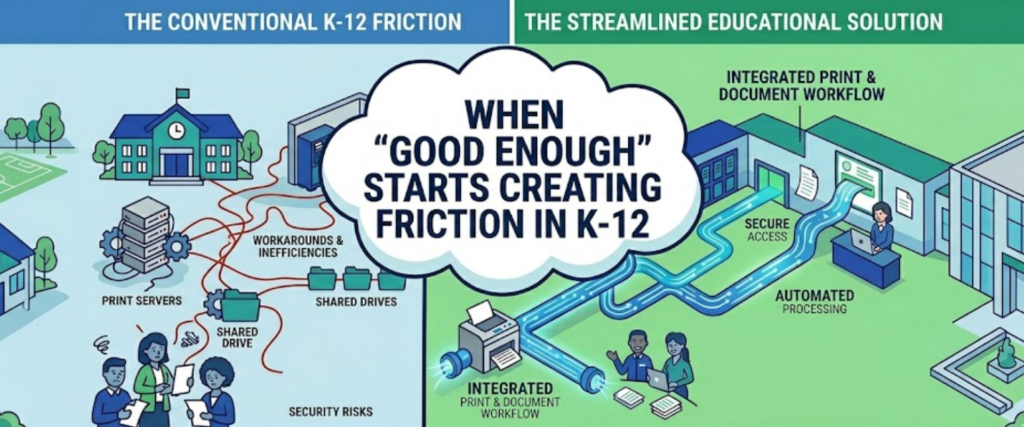
When “Good Enough” Starts Creating Friction in K-12
Most schools already have something in place. A print solution. A scan workflow. A shared drive. A process that has existed for years and technically still works.
The mistake is assuming that means the environment is working well.
In many K-12 environments, “good enough” slowly turns into operational friction. Staff adapt to inefficient processes over time, and eventually those workarounds become part of the daily routine.
That is usually where the real conversation begins.
Schools Are Full of Workarounds
K-12 environments are incredibly resourceful. If a process feels clunky or disconnected, staff find ways to keep things moving. Documents get scanned manually. Shared credentials start circulating. Teachers create their own systems because the official process takes too long.
From the outside, everything appears functional.
Inside the district, it often feels frustrating and difficult to manage consistently.
“Working” and “Working Well” Are Very Different Things
This is where many reseller conversations lose momentum. A school may already have print management, but that does not necessarily mean the environment is simple to maintain. It may still rely heavily on print servers, outdated deployment methods, or workflows that consume unnecessary IT time.
That is one reason PaperCut Hive resonates so quickly in education.
The conversation is rarely about replacing everything. More often, schools are looking for ways to simplify what has gradually become difficult to support.
The Real Opportunity Usually Shows Up Later
Once the conversation moves beyond print alone, larger operational gaps start surfacing naturally. Schools begin talking about access control, document routing, visibility, and the amount of manual work staff still handle every day.
This is where solutions like AuthX and Umango become part of a broader operational discussion.
Not because the reseller forced a product pitch, but because the school is already describing the friction themselves.
The strongest K-12 conversations focus less on individual products and more on reducing operational drag across the environment.
Better Questions Lead to Better Conversations
Instead of asking whether a school needs a specific solution, ask what still feels frustrating.
What processes take longer than they should?
What generates the most support tickets?
What still feels manual?
Those answers often reveal far more than a traditional discovery checklist.
In many cases, they uncover opportunities the customer had not even considered yet.
Schools Are Trying to Simplify
Districts are balancing growing workflow demands, tighter IT resources, and increasing privacy expectations all at the same time.
Most are not looking for more technology.
They are looking for fewer headaches.
The resellers who understand that are the ones who continue growing the relationship long after the initial print conversation ends.
Takeaway
In K-12, “good enough” technology often hides the biggest operational inefficiencies.
The real opportunity usually lives inside the workarounds schools have accepted as normal.
As an Authorized Solution Center, ecoprintQ helps ecoPartners connect print, security, and workflow conversations into a more strategic approach for K-12 environments.

ecoprintQ
Headquarters US
Call us
Mon-Fri from 8am to 8pm
(800) 236-8499
Discuss Sales
Our friendly team is here to help
sales@ecoprintq.com
Support
We are always here to assist
support@ecoprintq.com


Contact Us